
Ospedale San Carlo di Nancy
Italia, Roma
Alessandro Calarco
19 años de experiencia

Clínica certificada por : 



Revisado médicamente por
Fahad Mawlood
| Italia | España | Turquía | |
|---|---|---|---|
| Nefrectomía con Robot Da Vinci | ≈ $11,500 | de $24,700 | de $18,500 |
Bookimed no añade cargos adicionales a los precios de Nefrectomía con Robot Da Vinci. Las tarifas proceden de las listas de precios oficiales de las clínicas. Pagará directamente en la clínica por su Nefrectomía con Robot Da Vinci a su llegada al país.
Bookimed está comprometido con su seguridad. Solo trabajamos con las clínicas que mantienen altos estándares internacionales en Nefrectomía con Robot Da Vinci y tienen las licencias necesarias para atender a pacientes internacionales en todo el mundo.
Bookimed ofrece asistencia experta gratuita. Un coordinador médico personal le apoya antes, durante y después del tratamiento, resolviendo cualquier problema. Nunca estará solo en su viaje médico de Nefrectomía con Robot Da Vinci.

Día 1: Llegada
Día 2: Preoperatorio
Día 3: Cirugía
Día 4-7: Postoperatorio
Semana 1-2: Rehabilitación
Semana 3-4: Rehabilitación
Semana 5-6: Resultado Final
Tenga en cuenta que el proceso de recuperación de cada paciente es individual. Siga siempre los consejos de su proveedor de atención médica.

Clasificado entre los investigadores de urología más influyentes de la última década, el Prof. Montorsi dirige la cirugía robótica en San Raffaele.

Especialista en cirugía robótica mínimamente invasiva para el cáncer de riñón: el Dr. Saltutti realiza nefrectomías utilizando el sistema Da Vinci en el Hospital Maria Cecilia.
El Dr. Calarco se especializa en cirugía urológica mínimamente invasiva, incluyendo la nefrectomía con el robot Da Vinci. Su formación internacional y su investigación se centran en técnicas avanzadas.


 Olena Sikoza
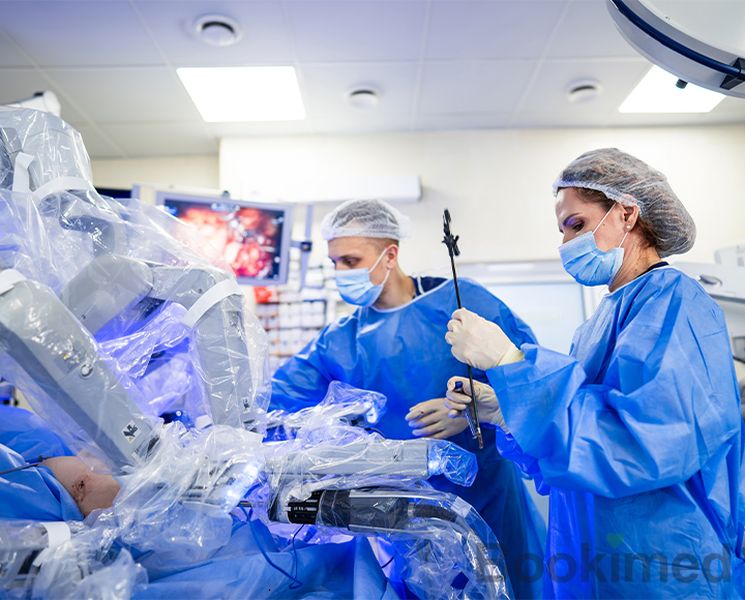
Este procedimiento consiste en la extirpación asistida por robot de un riñón utilizando el sistema quirúrgico Da Vinci para una operación de precisión y mínimamente invasiva.
La nefrectomía robótica en Italia ofrece una seguridad superior en los resultados perioperatorios, con tasas de complicaciones intraoperatorias 5 veces menores que la cirugía abierta según los datos clínicos. El sistema da Vinci reduce significativamente la pérdida de sangre y la estancia hospitalaria de 2 a 3 días, manteniendo un control del cáncer y una función renal a largo plazo equivalentes.
Opinión del experto de Bookimed: Aunque la cirugía robótica requiere entre 30 y 40 minutos más de preparación, los centros italianos de alto volumen aprovechan su extrema especialización. Por ejemplo, el Prof. Dr. Francesco Montorsi en el San Raffaele ha publicado más de 1.000 artículos, lo que demuestra que la seguridad clínica italiana se basa en la combinación de grandes volúmenes quirúrgicos con un acceso de alta densidad a más de 200 plataformas robóticas
La preparación para una nefrectomía robótica Da Vinci en Italia se centra en la optimización física, la interrupción estricta de medicamentos y las pruebas preoperatorias. Los pacientes deben alcanzar un IMC inferior a 25 y suspender los anticoagulantes de 7 a 10 días antes. Especialistas italianos como el Prof. Francesco Montorsi utilizan modelos de tomografía computarizada (TC) en 3D para la planificación quirúrgica.
Perspectiva del experto de Bookimed: Aunque muchos centros europeos ofrecen cirugía robótica, los hospitales italianos como el Ospedale San Carlo di Nancy se especializan en programas robóticos de alto volumen. Nuestros datos muestran que cirujanos italianos de primer nivel como el Prof. Francesco Montorsi han realizado más de 8,000 procedimientos. Este alto volumen a menudo se traduce en una
Durante una nefrectomía robótica en Italia, los cirujanos utilizan el sistema Da Vinci para realizar la extirpación del riñón a través de 3 a 4 incisiones diminutas. El cirujano opera desde una consola, utilizando una magnificación 3D de alta definición e instrumentos articulados que brindan mayor precisión que las herramientas laparoscópicas tradicionales.
Perspectiva del experto de Bookimed: Aunque muchos se centran en el robot, el volumen personal de cirugías del médico en Italia es la verdadera señal de seguridad. El Prof. Dr. Francesco Montorsi en San Raffaele ha realizado más de 8,000 cirugías urológicas. Es más probable que los especialistas con un alto volumen de casos como él manejen pinzamientos vasculares complejos de forma robótica sin nec
La recuperación tras una nefrectomía robótica en Italia suele durar de 2 a 6 semanas para las actividades diarias. La mayoría de los pacientes pueden volar con seguridad entre 10 y 14 días después de la operación. La vigilancia crucial incluye controlar la fiebre, los cambios en el color de la orina y los signos de coágulos sanguíneos durante el viaje.
Perspectiva del experto de Bookimed: Aunque la cirugía robótica reduce el trauma, la regla de los 14 días para volar es estrictamente para la curación interna. Clínicas como el Ospedale San Carlo di Nancy en Roma atienden a 15.000 pacientes al año. Sus datos sugieren que los pacientes que vuelan antes del día 10 a menudo reportan hinchazón y molestias significativas.
Consenso de los pacientes:
Los pacientes no son candidatos para una nefrectomía robótica en Italia si padecen una enfermedad cardiopulmonar grave, trastornos hemorrágicos no corregidos o tumores avanzados que invaden la vena cava. Las cicatrices abdominales extensas y la obesidad extrema también dificultan la maniobrabilidad de los brazos robóticos y la seguridad quirúrgica en los centros de urología italianos.
Perspectiva del experto de Bookimed: Los centros de cirugía robótica italianos como el Ospedale San Carlo di Nancy se centran mucho en el cribado preoperatorio. Nuestros datos muestran que los centros especializados a menudo redirigen primero a los pacientes con un IMC superior a 35 a programas nutricionales. Este trabajo de preparación tiene como objetivo reducir el riesgo de convertir un procedimiento robótico en una cirugía abierta.
Consenso de los pacientes: Los antiguos pacientes enfatizan que
Las nefrectomías robóticas de alto volumen en Italia se concentran en centros terciarios como el Hospital San Raffaele de Milán y el Ospedale San Carlo di Nancy de Roma. Estos centros utilizan sistemas Da Vinci para oncología urológica compleja, dirigidos por cirujanos que realizan frecuentemente más de 50 casos robóticos al año.
Opinión de expertos de Bookimed: Aunque la reputación del hospital importa, el volumen de casos personales del cirujano es la señal de calidad más fuerte. El Prof. Dr. Francesco Montorsi en San Raffaele tiene más de 1.000 trabajos de investigación publicados y 8.000 cirugías. Esta experiencia específica en técnicas robóticas se correlaciona directamente con las tasas de complicaciones más bajas encontradas en los centros milaneses de alto volumen.
Consenso de lo
La cirugía renal robótica deja de 3 a 5 cicatrices lineales pequeñas de aproximadamente 8 a 12 milímetros de largo. Los cirujanos en Italia utilizan técnicas mínimamente invasivas que requieren solo pequeñas incisiones de ojo de cerradura. Un sitio puede ser ligeramente más grande para la extracción de tejido, pero estas marcas generalmente se desvanecen significativamente dentro de los 12 meses.
Perspectiva del experto de Bookimed: Aunque las cicatrices pequeñas son estándar, los mejores urólogos de Italia, como el Prof. Dr. Francesco Montorsi en San Raffaele, han realizado más de 8.000 cirugías. Este nivel de experiencia a menudo se traduce en una colocación más precisa de los puertos. Los cirujanos experimentados pueden utilizar mejor los pliegues naturales de la piel para ocultar estas pequeñas incisiones. Elegir un centro de alto volumen en Mi