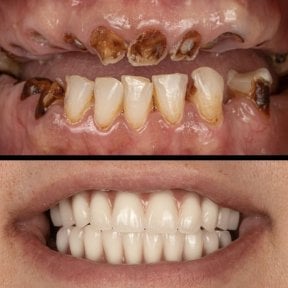
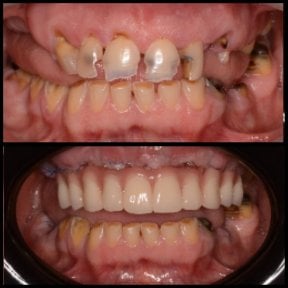
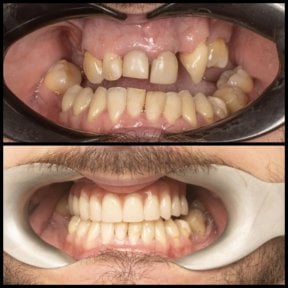
About 96 in every 100 dental implants are still in place 10 years after surgery. A dental implant in Poland is a staged treatment, not a single appointment. Getting it right means planning the trips around the healing, flying home at the right time and protecting the result for years. Here's how to stay in that group.
How Long Do Dental Implants in Poland Take?
Most patients can't finish dental implants in Poland in one short trip, and that's by design. The bone needs months to grip the titanium post before it can hold a permanent tooth. Your surgeon maps the full plan from a CBCT scan, a 3D X-ray of your jaw. That happens before anything is booked. Some patients qualify for same-day options, but most treatment is staged. The two-trip plan is the route Bookimed coordinates most often for Poland.
The two-trip plan
The safe route is usually two visits, known as the two-stage protocol, with the healing months in between.
- Trip 1, about 3–5 days. The surgeon takes the scan, removes any failing teeth, does any grafting, and places the implant.
- Healing at home, about 3–6 months. The jawbone slowly fuses to the post, and this is the part nobody can rush.
- Trip 2, about 5–7 days. You come back for the connector and the permanent zirconia or porcelain crown.
Any temporary crown fitted in the meantime is there for looks only. It's kept out of your bite, so you never chew on a post that's still fusing.
When a graft adds a third trip
Sometimes the upper jaw has lost too much bone to hold an implant. A larger repair, like a sinus lift or block graft, heals on its own for about 4–6 months first. Only then does the implant go in. That turns the plan into three trips. Your surgeon can see from the CBCT scan whether this applies to you.
When a front tooth can be done in one visit
A single front tooth can sometimes be placed and given a temporary tooth in one visit. This works only in a narrow set of conditions. The front bone wall must be intact and the neighbouring teeth healthy. There must be no active infection, and the new post must be firmly stable. Implant specialists treat this as a complex case, so the surgeon confirms it from your scan on the day.
Are You a Good Candidate for a Dental Implant?
A dental implant suits most adults with healthy gums and enough jawbone. Suitability is the surgeon's call, made from your scan and health history. It's not a checklist you fill in yourself.
What a surgeon checks before treatment
The surgeon assesses three findings before planning treatment. Bone volume and quality come from your CBCT scan. Gum health and your general medical history complete the picture. This is why a proper plan starts with imaging, not with a booking.
Health factors that support healing
Four factors change how reliably an implant heals: smoking, diabetes control, untreated gum disease and night-time grinding. Each one has a straightforward fix:
- Stop smoking at least 4 weeks before surgery, and stay smoke-free through the 3–6 month healing phase. Smoking slows healing and raises the chance of graft problems.
- If you have diabetes, keep blood sugar well controlled, and have any active gum disease treated before surgery. Both support long-term implant success.
- Wear a custom nightguard if you grind your teeth at night, which protects the implant while you sleep.
How to Keep Your Implants for Life
The strongest protection for an implant is a professional cleaning and check about every 6 months. Mild gum inflammation can appear around an implant over the years. This reversible condition is called peri-implant mucositis, and a dentist catches it early at those visits. Untreated, it can progress to peri-implantitis, the stage where the bone around the post is lost. A systematic review puts mucositis at about 43% of patients and peri-implantitis at about 22%, which is what the 6-month checks are for.
When Is It Safe to Fly Home?
Your treatment plan sets your return date, so it helps to know the flight rules in advance. The safe wait depends on which operation you had.
Why flying too soon is a problem
Cabin air is kept at the pressure you'd feel at about 5,000–8,000 feet, not at sea level. At that pressure, trapped gas expands by roughly 30% as the plane climbs and shrinks again as it lands.
A tiny air pocket under a fresh temporary crown or filling can expand the same way. It presses on the tooth, causing a sharp pressure pain that dentists call barodontalgia. After an upper-jaw graft or sinus lift, the thin sinus membrane is only about 0.3–0.8 mm across. This layer, called the Schneiderian membrane, is sensitive to pressure changes that can disturb fresh graft material. That's why sinus work needs the longest wait.
Safe waiting times before you fly
Minimum waits lengthen with how involved the surgery was. Research on flying after oral surgery gives a useful guide:
| Procedure | Earliest safe flight |
|---|
| Single implant, no graft | about 72 hours |
| Surgical tooth extraction | about 72 hours |
| Bone graft without a sinus lift | about 72 hours |
| Sinus lift or large upper-jaw graft | at least 2 weeks, up to 6 weeks for long-haul flights |
Your surgeon knows whether you need a sinus lift before you travel. So book a flexible or later return flight if there's any chance of one. Confirm your own safe window with the surgeon before fixing your return flight.
Arranging Follow-Up Care at Home: Your Implant Passport
Once you're home, an implant needs little beyond good brushing and your normal check-ups. But a crown might one day need tightening, or a part might need servicing. A dentist near you has to know exactly what was placed. Ask the clinic for a written implant passport before you leave.
What to put in your implant passport
Your implant passport should record:
- Which brand and system was used, meaning the manufacturer and product line.
- The model number, and how the crown attaches to the post.
- Exact diameter and length, in millimetres.
- Your CBCT scan, treatment notes and warranty documents, kept together.
A dentist back home needs those exact details to order the matching parts and driver keys. That matters if anything is ever adjusted.
Why globally recognised brands matter
The brand of implant matters more than it first seems. An internationally established system such as Straumann or Nobel Biocare has compatible parts stocked around the world. So any qualified dentist can service it. Lesser-known systems are far harder to match parts for later. Your Bookimed coordinator stays in touch after you return and can help you reach the clinic with any questions. The Polish clinics Bookimed partners with keep these records and share them on request.
How to Keep Your Implant Warranty Valid
A warranty on your implants is only as strong as the conditions attached to it. Most of those conditions are about upkeep and paperwork. Knowing them from the start keeps your cover intact.
Conditions that usually keep a warranty valid:
- A documented professional cleaning about every 6 months keeps the cover in force, so keep the invoices.
- Leaving other missing teeth unrestored can overload the new implants, and some warranties shorten if that's left undone.
Common exclusions to expect:
- Provisional crowns and bridges are usually not covered.
- Age-related change in the jaw over time is a natural exclusion.
- Smoking-related graft problems, and grinding damage unless you wear a custom nightguard.
Implant makers run their own warranty programmes too, and those also depend on genuine parts and proper documentation. Ask for the full warranty terms in writing before treatment, so you know what keeps your cover in force.
How to Check Your Polish Implantologist's Credentials
Every Polish clinic Bookimed partners with is licensed, and its implant surgeons are vetted before they join. You don't have to chase paperwork on your own. Here's what that assurance covers.
- Your Bookimed coordinator can confirm a surgeon's licensing and training on request, before you commit.
- The coordinator can also confirm implant-focused memberships like the ITI, ICOI, or PSI (the Polish Association of Implantology).
- You can ask the clinic directly which implant systems the surgeon places most often.
These checks let you settle into trained, licensed hands without doing the digging yourself.